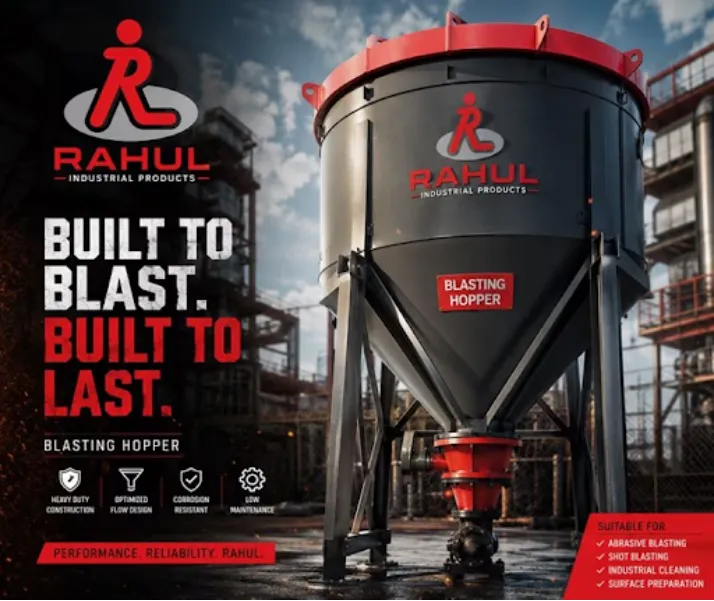
Abrasive blasting performance depends on more than the blasting machine itself. One of the most important components influencing productivity is the blasting hopper. The hopper controls abrasive storage and flow, directly affecting blasting consistency, media consumption, and overall efficiency.
Manufacturing facilities across Pimpri-Chinchwad increasingly focus on optimizing blasting operations to reduce downtime and improve production quality. Selecting the right hopper contributes significantly to those goals.
Understanding the Purpose of a Blasting Hopper
The hopper stores abrasive material and delivers it to the blasting system at a controlled rate.
Consistent abrasive flow helps maintain:
- Uniform cleaning quality
- Stable blasting pressure
- Reduced media wastage
- Improved operator control
Poor abrasive flow often causes uneven surface preparation and unnecessary production delays.
Signs of an Inefficient Hopper
Several issues may indicate that the existing hopper is not performing efficiently.
These include:
- Frequent abrasive blockages
- Irregular blasting patterns
- Excessive abrasive consumption
- Interrupted blasting cycles
- Difficulty controlling media flow
Ignoring these problems can increase operating costs over time.
Important Features to Evaluate
Industrial buyers should compare several design features before selecting a blasting hopper.
Capacity
Larger hoppers support longer blasting cycles with fewer interruptions.
Material Quality
Heavy-duty steel construction improves durability under continuous industrial use.
Moisture Resistance
Dry abrasive flows more consistently than damp media.
Flow Control Mechanism
Accurate metering improves blasting precision and reduces waste.
Easy Refilling
Convenient loading minimizes production downtime.
Matching Hopper Size to Production Needs
The correct hopper size depends on:
- Daily blasting volume
- Type of abrasive used
- Number of operators
- Equipment configuration
- Project duration
Oversized equipment may increase costs unnecessarily, while undersized units create frequent production interruptions.
Best Practices for Better Performance
To maximize efficiency:
- Store abrasives in dry conditions.
- Remove moisture from compressed air.
- Inspect valves regularly.
- Replace worn seals.
- Clean internal surfaces periodically.
Simple maintenance significantly improves reliability.
Industries That Benefit Most
Blasting hoppers are widely used in:
- Automotive manufacturing
- Structural steel fabrication
- Heavy engineering
- Foundries
- Construction equipment manufacturing
- Pipeline fabrication
- Industrial maintenance
Each application demands consistent abrasive delivery to maintain production standards.
When sourcing blasting equipment, manufacturers often benefit from suppliers capable of recommending complete system compatibility rather than individual components alone. Rahul Industrial Products supports industries throughout Pimpri-Chinchwad by supplying blasting equipment and complementary industrial engineering products suited to diverse manufacturing environments.
Selecting a properly designed blasting hopper improves abrasive efficiency, enhances cleaning consistency, and contributes to smoother industrial operations.
Keywords