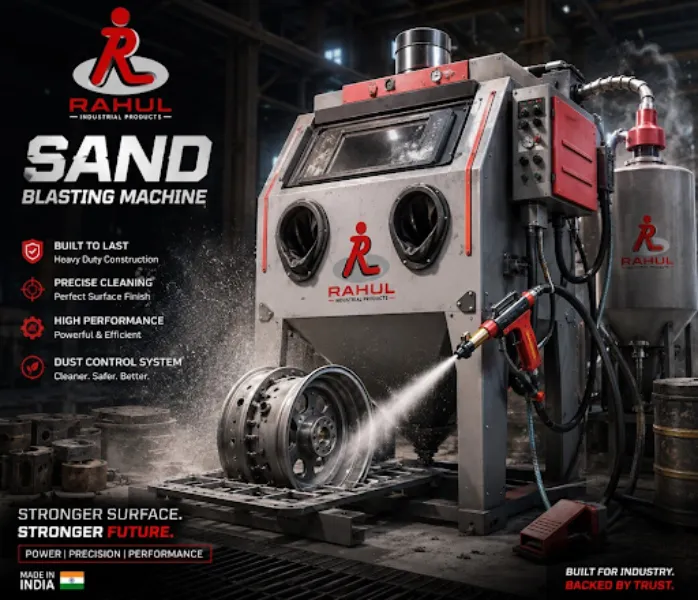
Paint and protective coatings perform best when the underlying surface has been prepared appropriately. Rust, mill scale, previous coatings, and other contaminants can interfere with coating adhesion. This makes abrasive blasting an important preparation method in many industrial environments and explains why selecting the right Sand Blasting Equipment supplier requires understanding the complete process.
Heavy engineering and fabrication businesses in Bhosari, Maharashtra, often handle metal components that need surface preparation before painting, coating, inspection, or refurbishment.
Understanding Abrasive Blasting
Abrasive blasting propels suitable abrasive media against a surface to remove unwanted material and create the required surface condition.
Although the term sand blasting remains widely used in searches, industrial operations may use different approved abrasive media depending on the substrate, process specification, equipment, and applicable safety requirements.
The correct media should always be selected according to the application.
Main Parts of a Blasting Setup
A blasting system can involve several interconnected components rather than a single machine.
Depending on the configuration, these may include:
- Blast pot
- Blasting hose
- Nozzle
- Couplings
- Air supply components
- Moisture management equipment
- Control devices
- Appropriate protective equipment
Each part influences how effectively the overall setup performs.
Air Supply Has a Major Impact
Compressed-air capacity is one of the most important considerations in abrasive blasting.
A system may have suitable blasting equipment but still perform poorly when the compressor cannot maintain the required airflow and pressure for the selected nozzle and operating conditions.
Buyers should therefore assess the blasting machine, compressor capacity, hose arrangement, and nozzle requirements together.
Surface Preparation Requirements Differ
A component being cleaned before general repainting may not need the same preparation standard as a surface receiving a specified industrial protective coating.
Before equipment selection, teams should establish:
- Base material being treated
- Existing surface condition
- Required cleanliness
- Desired surface profile
- Coating specification
- Production volume
- Working environment
These factors help determine a suitable blasting arrangement.
Moisture Can Affect Performance
Compressed air can contain moisture, particularly under certain environmental and operating conditions. Moisture entering a blasting system may contribute to abrasive flow problems and inconsistent operation.
Suitable air preparation and routine inspection can therefore be important parts of the setup.
Surface Preparation Is a Complete Process
Rahul Industrial Products supports industrial customers requiring blasting and surface-preparation equipment. When selecting equipment, businesses benefit from discussing the complete application rather than purchasing individual components without considering compatibility.
Effective abrasive blasting depends on the relationship between air supply, blasting equipment, abrasive media, nozzle selection, surface condition, and the coating specification that follows.
For manufacturing and fabrication teams, understanding these variables before equipment selection can reduce avoidable process problems and create a more controlled foundation for subsequent painting and coating work.
Keywords