Rust scale, mill scale, oil, salts and old coatings do not all respond to blasting in the same way, and a visually bright surface is not automatically ready for paint. By following the cleaning sequence, selecting the right abrasive and verifying cleanliness, profile, dust and soluble salts, you can decide whether abrasive blasting will produce a sound substrate for finishing.
Key takeaways
- Use abrasive blasting to remove rust, mill scale, old coating and weld residue.
- Match abrasive hardness and size to the required cleanliness and anchor profile.
- Adjust nozzle pressure, distance and angle to control cleaning speed and profile.
- Check dust, salts, moisture and surface profile before applying the finish.
What abrasive blasting removes from steel—and what it leaves behind
Compressed air does not dissolve corrosion: it drives abrasive particles through a nozzle at high velocity. Impact fractures rust scale, mill scale, old coating and weld residue, while cutting a controlled anchor profile into steel. Loose surface rust comes off readily; tightly adherent scale needs sufficient energy and suitable media.
Blasting alone is not a dependable oil, grease or soluble-salt treatment.
1. Look for oil and grease before blasting. Degrease them and verify the surface; blasting can smear oil, contaminate the abrasive and leave a film behind.
2. Mark moisture, condensation and wet areas. Dry the steel, because water promotes flash rust and can hide salts.
3. Inspect welds for spatter, slag, sharp edges and unfinished toes. Remove defects mechanically; abrasive blasting will not correct a dangerous edge or poor weld geometry.
4. Check laminations, deep pits and embedded dirt. Record defects before cleaning so a newly exposed flaw is not mistaken for blast damage.
5. Identify mill scale, loose rust, old coating and other residues, then define the required cleanliness grade, such as Sa 2½ under ISO 8501-1, rather than accepting “clean.”
After blasting, inspect for remaining scale, patchy cleaning, embedded abrasive and dust in pits. Check dust using the ISO 8502-3 tape method. Dry-blasted steel can rust again as humidity and temperature change; wet or vapor blasting reduces airborne dust but adds wastewater and flash-rust control. Prime within the coating procedure’s specified window.
How to choose abrasive media without overprofiling the steel
Choose the least aggressive abrasive that reaches the specified cleanliness grade and anchor profile. A coarse or very hard abrasive can remove scale quickly, but it also cuts deeper valleys, increases consumption and leaves a profile the coating cannot properly cover.
| Media | Particle size | Hardness and likely result |
|---|---|---|
| Steel shot | Fine to medium | Spherical, reusable particles peen and clean with a relatively shallow profile; choose it when low-profile cleaning is required and the equipment supports recovery. |
| Steel grit | Fine to medium | Angular, hard particles cut rust and mill scale and create a sharper, deeper anchor pattern; select the smallest grade that meets the coating specification. |
| Copper slag | Fine to medium | Angular, single-use abrasive that cuts firmly and cleans quickly; use it for heavy scale only when its resulting profile and potential embedded residues are acceptable. |
| Mineral abrasives | Fine to medium | Hardness varies by material; garnet cuts efficiently, while softer minerals reduce aggressive cutting. Confirm the supplier’s hardness and contamination data before selection. |
Particle size controls impact energy and profile depth: increase size only when smaller particles cannot remove tightly adherent scale. Hardness controls cutting action; excessive hardness can overprofile steel, while insufficient hardness leaves residues behind.
Set the choice against the coating manufacturer’s profile range, then verify the result with ASTM D4417 depth micrometer, replica tape or visual comparator methods. Blast cleaning does not prove profile compliance.
Examine the measured pattern, not just the visual colour of the steel, and reduce abrasive size or aggressiveness if the valleys exceed the specified range.
How nozzle settings control cleaning speed and anchor profile
Cleaning speed rises only when the nozzle receives enough air to maintain abrasive velocity; a larger orifice without compressor capacity causes pressure loss and slower work. The resulting anchor profile also changes with each setting, so a clean-looking surface does not prove a specified depth.
- Blasting nozzle diameter: A larger bore increases abrasive flow and coverage when the compressor sustains nozzle pressure. It cleans faster but can deepen the profile; a smaller bore concentrates the jet and reduces output.
- Nozzle material: A hard, wear-resistant nozzle preserves the designed orifice. A worn nozzle enlarges the opening, changes abrasive flow and creates an uneven anchor profile across the same workpiece.
- Nozzle pressure: Check pressure at the nozzle under operating flow, not on a static compressor gauge. Higher pressure increases impact and cleaning rate until it causes excessive profile, abrasive breakdown or steel damage.
- Stand-off distance: Hold the nozzle too far away and the jet spreads, loses velocity and cleans slowly. Move too close and the narrow impact zone can produce an uneven, overly deep pattern.
- Blast angle: A near-perpendicular angle transfers more energy into rust scale and steel, producing faster cutting and stronger profile. A shallow angle sweeps contamination away with less profile development.
- Traverse speed: Move slowly for heavy scale, but stop before repeated passes overclean sound steel. Fast travel leaves patches; slow travel increases exposure and profile depth.
Measure the finished profile separately with an ASTM D4417 depth micrometer, replica tape or visual comparator. Change one setting at a time during trials so you can identify its effect.
When to use a blast machine—and when another method is safer
Choose the method by workpiece size, containment, access and contamination risk—not simply by how heavy the rust looks.
| Option | What it means | When it applies |
|---|---|---|
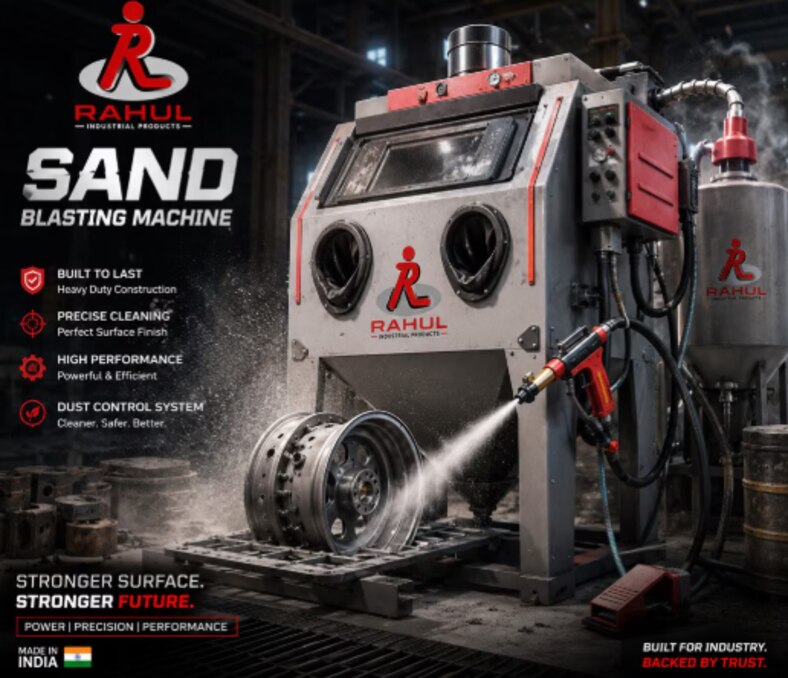
| Pressure blast machine | Compressed air forces abrasive from a pressurised vessel through the nozzle. | Use for fast, uniform cleaning of fabricated parts, structural steel and production work where recovery or enclosure is available. |
| Suction blast cabinet | Airflow draws abrasive into the nozzle from a cabinet hopper. | Use for small parts, controlled nozzle work and lighter deposits; it is slower on heavy mill scale. |
| Portable blast pot | A mobile pressurised vessel feeds abrasive through a hose and nozzle. | Use for tanks, beams, pipelines and site repairs where the work cannot enter a cabinet. |
| Wet blasting | Water accompanies the abrasive and suppresses airborne dust. | Use near occupied areas or where dust control is critical, but plan wastewater collection and immediate flash-rust control. |
| Mechanical cleaning | A needle gun, wire wheel, scraper or power tool breaks or abrades contamination without free abrasive. | Use for small repairs, edges, localised rust or sites where blasting containment is impractical. |
Do not blast oily steel: degrease it first, or the impact can spread oil over the surface and contaminate the abrasive. Choose mechanical cleaning for thin sheet, delicate details or substrates that could distort under impact.
Abrasive blasting is unsuitable where you cannot contain dust, collect spent abrasive or manage wastewater. Avoid it when the coating specification prohibits an anchor profile, when soluble salts remain untreated, or when sparks and dust create an uncontrolled fire or explosion hazard. Define the cleanliness grade and permitted flash-rust condition before selecting wet blasting.
How to verify the blasted surface before applying the finish
A clean-looking surface is not ready for coating until you verify five separate conditions: visual cleanliness, anchor profile, soluble salts, dust and compressed-air quality. Check them after blasting, after dust removal and before the first coat.
| Check | What to verify | Failure consequence |
|---|---|---|
| Cleanliness | Use SSPC-SP 10 for near-white metal, or SSPC-SP 6 for commercial blast cleaning, as specified for the coating. Remove visible rust, mill scale, old coating and dirt. | Remaining scale or coating becomes a weak layer beneath the finish. |
| Surface profile | Measure the peak-to-valley height with ASTM D4417. Compare it with the coating specification’s minimum and maximum range. | A shallow profile reduces adhesion; excessive peaks remain undercovered by the dry film. |
| Soluble salts | Test extracted surface contamination for conductivity using ISO 8502-9, then compare the result with the coating specification’s limit. | Chloride or sulfate can cause blistering and premature corrosion despite a clean appearance. |
| Dust | Apply the pressure-sensitive tape method in ISO 8502-3 and record dust quantity and particle size. | Dust trapped in anchor valleys acts as a weak interlayer. |
| Compressed air | Perform the ASTM D4285 blotter test at the nozzle for oil or water. | Oil or moisture causes adhesion loss, blistering and finishing defects. |
Inspect flash rust separately, especially after wet or vapor blasting. Prime within the manufacturer’s stated window and only at the permitted flash-rust grade; stop if rust has progressed beyond that condition. Rahul Industrial Products can help you match blasting equipment and hose selection to a procedure that includes these checks.
Related products
 | Blasting Equipment Supplier in India – Rahul Industrial Products Rahul Industrial Products is a leading distributor, dealer, and supplier of high-performance Sand... View product → |
 | Blasting Equipment Supplier in India – Rahul Industrial Products Rahul Industrial Products is a leading distributor, dealer, and supplier of high-quality blasting hoses... View product → |
Frequently asked questions
What does abrasive blasting remove from steel?
Abrasive blasting removes loose and adherent rust, mill scale, old coatings, weld residue and other surface contaminants. It also leaves an anchor profile that helps a coating adhere.
How do you choose abrasive media without overprofiling steel?
Choose media size and hardness according to the steel thickness, contaminant and coating specification. Use the least aggressive media that reaches the required cleanliness and profile, then measure the profile before coating.
How do nozzle settings affect blasting results?
Nozzle pressure, distance, angle, size and travel speed control impact energy, cleaning rate and anchor profile. Excessive pressure or slow movement can deepen the profile and waste abrasive.
When is abrasive blasting the wrong method?
Use another method when blasting could damage thin or delicate steel, spread hazardous contamination, embed abrasive, or create unacceptable dust. Consider wet blasting, vacuum blasting, power tools or chemical removal after assessing the surface and work area.
How do you verify a blasted surface before finishing?
Inspect the surface for remaining rust, mill scale, coating, dust and visible moisture. Check soluble salts and measure the surface profile with suitable test equipment, then confirm the result against the coating specification.
Related products
 | Blasting Equipment Supplier in PCMC – Rahul Industrial Products Rahul Industrial Products is a leading distributor, dealer, and supplier of high-quality Shot Grit in... View product → |
 | Blasting Equipment Supplier in India | Rahul Industrial Products Rahul Industrial Products is a leading distributor, dealer, and supplier of high-quality blasting... View product → |
 | Blasting Equipment Supplier in India – Rahul Industrial Products Rahul Industrial Products is a trusted leading distributor, dealer, and supplier of high-quality... View product → |
 | Blasting Equipment Supplier in India – Rahul Industrial Products Rahul Industrial Products is a leading distributor, dealer, and supplier of high-quality Blasting... View product → |